





Whichit

From Engagement to Sale in Five Steps

Elliott-Saray.png

Elliott Saray
Senior Developer


Supercharge your CRM with Whichit’s Microsoft Dynamics365 Integration

 Whichit has enhanced their integration capabilities by establishing a direct connection between interactive commercial content served online and one of the industry’s most powerful CRMs: Microsoft’s Dynamics365.

 Using Whichit’s Dynamics365 integration, businesses can instantly streamline user information to their CRM. Data transmission is facilitated by Whichit’s naturally interactive content distributed across the web.


In this article, we will explain how a business can take five simple steps to turn a stranger engaging with their content online into a paying customer by using Whichit’s Microsoft’s Dynamics365 CRM integration.


Whichit for Enterprise

Whichit is a B2B software company providing an interactive commercial content platform that enables brands, marketers and advertisers to dramatically increase user engagement, return on marketing investment, open new revenue streams, and gain user-related insight.  The company developed an innovative technology that profiles users based on their preferences and uses machine learning to provide bespoke commercial incentives in real time.


The value of interactive commercial content

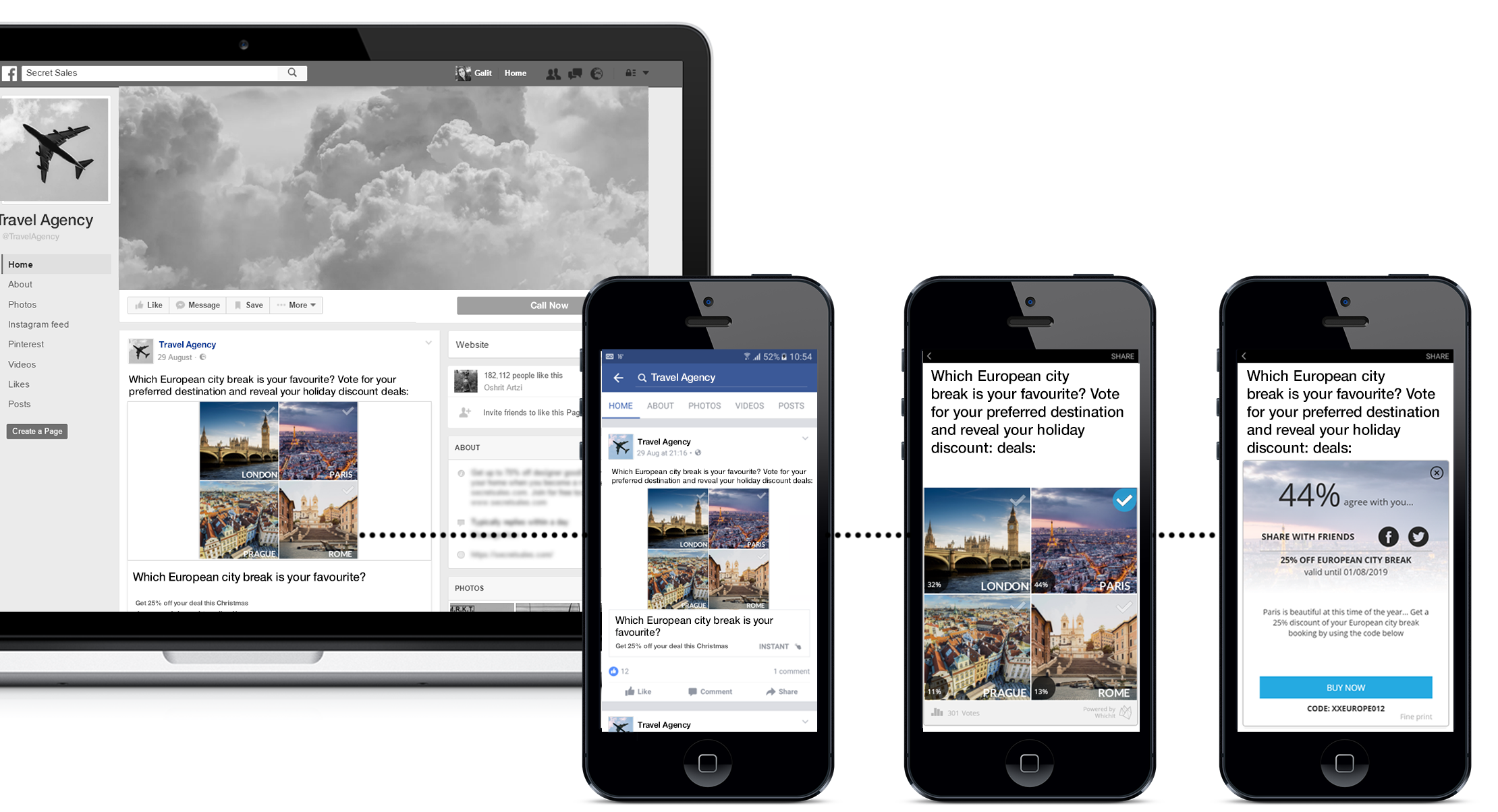
Using Whichit’s unique ad unit, businesses are able to spread their interactive content to a wide audience in the form of a fun, intuitive image-based poll or survey. Naturally interactive content allows businesses to directly gather preferences from their online audience— a one-to-one conversation occurs online between the business and their consumers.


Better yet, Whichit’s intelligent ad unit is able to perform preference-based segmentation; the ad unit offers the end user a commercial Engage Card suited to their needs and preferences. The Whichit ad unit is able to recognise a potential client and make a commercial offer in real-time.
 

Whichit multiple channels

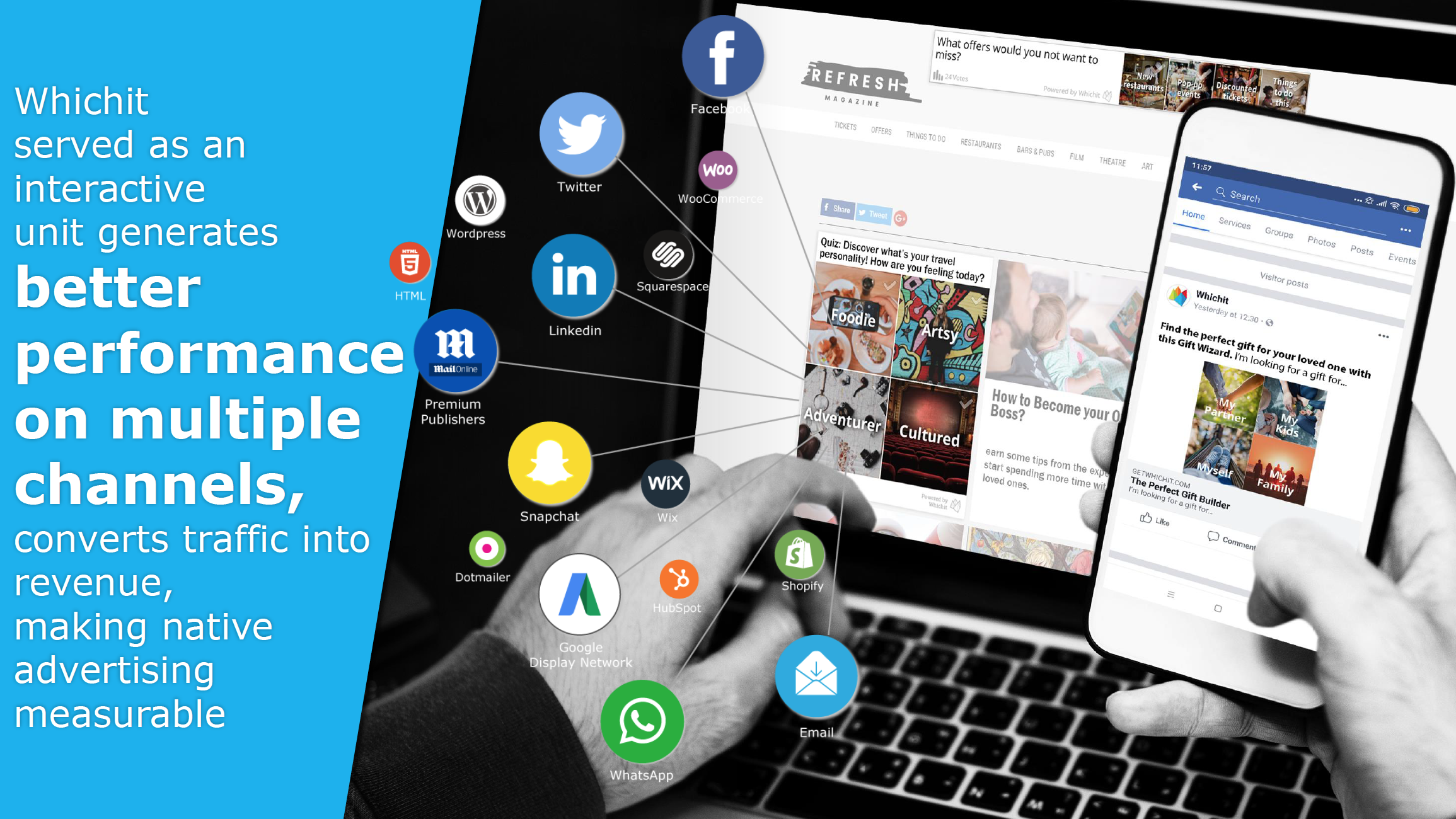
Touchpoints on any digital channel


As you may already know, Whichit’s interactive commercial content can be distributed to any digital channel. This includes placements native onsite, on social channels like Facebook or Twitter, banners on the Google Display Network and other DSPs, email marketing campaigns and messaging services like WhatsApp.

 Regardless of the chosen traffic sources, interactive content served by Whichit is able to consolidate and immediately deliver segmented user data to Dynamics365.


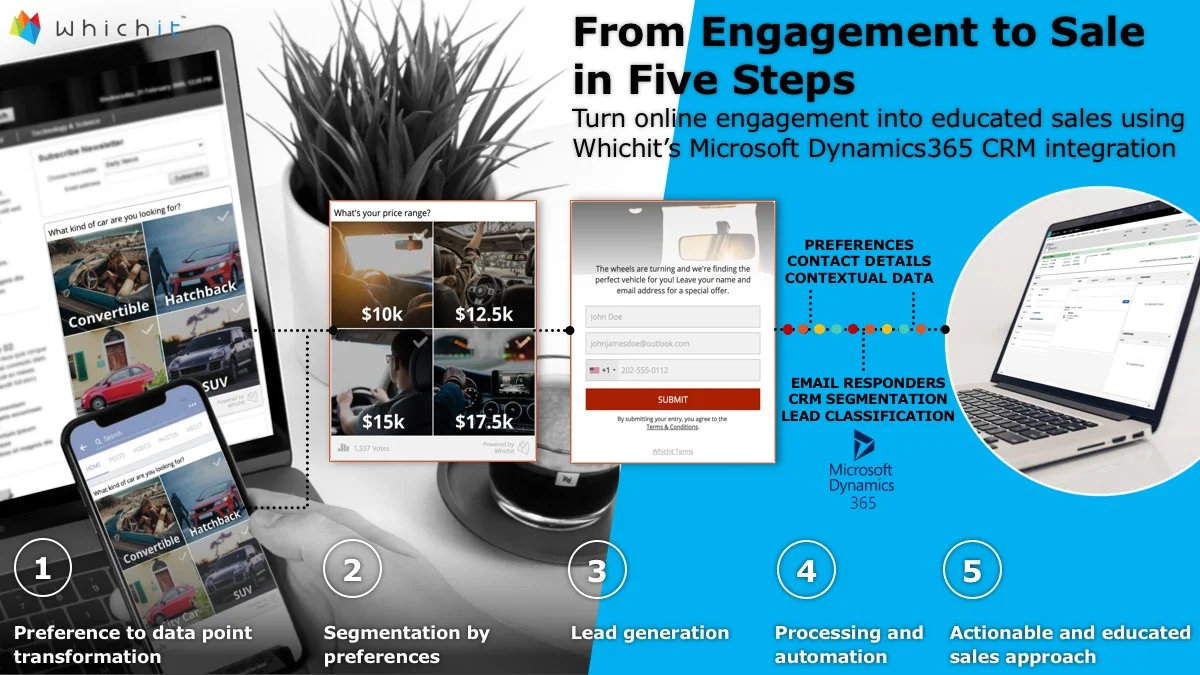
From engagement to sale in five steps
From Engagement to Sale in Five Steps Slide.jpg


1.   Preference to data point transformation

Each Whichit post circulating the web contains over 60 different data points that are used to better understand user preferences and create advanced user segmentation. Data collected by the Whichit ad unit can evolve immediately from a user preference to a real actionable data point for a business by contextualising the choices a user makes while interacting. Due to the simplicity and natural engagement of the creatives, the sky is truly the limit for what a business is able to understand about their audience by simply asking them online.

2.   Segmentation by preferences

Whichit ad units have the ability to digest end-user’s choices throughout their interactions with the ad. Each click or choice contributes to a personalised outcome right before their eyes; live segmentation allows businesses running Whichit campaigns to deliver bespoke commercial messages to their users online, based entirely on the choices they’ve made.

3.   Lead generation

Whichit provides businesses with several commercial message (Engage Card) types to choose from when building a campaign, but by far the most powerful commercial message for a business is the lead generation Engage Card.

 With Whichit, businesses are able to run fully GDPR-compliant lead generation campaigns that instantly deliver real end-user data. Once a lead is collected by the Whichit ad unit, the lead—and all the underlying data points based on their choices—can be sent directly to the business’ CRM.

4.   Processing and automation

One of the many reasons for business CRMs rising to popularity over the past five years is the value a CRM brings in terms of automation. Using a CRM such as Dynamics365, a business can setup email auto-responders and segment users within their CRM according to the campaign on which they sailed into the database.

Whichit takes the processing and automation functionalities of a typical CRM and provides them a much more valuable engine on which to segment and automate contacts: user preferences. A brand using Whichit can deliver leads into their Dynamics365 instance with precisely everything they need to know about said user, a user the business can then move onto the final stage with a rich understanding of their needs as a client.

5.   Actionable and educated sales approach

Thanks to the efficiency and the level of granular user detail provided by previous steps, this final stage could not be any simpler. The final phase of this process is to take the data your business has easily channelled into Dynamics365 and action it.

When a new lead arrives in Dynamics365 with full contact details, customer acquisition information and a full list of user choices, and is segmented correctly by the CRM’s internal sorting, the business can then continue their chosen sales process with an educated knowledge of their clients’ needs— phenomenally increasing the efficiency of the sales process by taking only a few steps beforehand.

------

If you’d like to use Whichit to take control of your data and take five steps to turn your engagements into sales, get in touch with us and we’ll be happy to help you! Email [email protected].

 

Find Whichit on Microsoft AppSource

The Impossible Work Of The Founder-CEO

Jonathan-Gan.png

Jonathan Gan
Founder & CEO


A tech-startup with a spectacular aura: innovative, disruptive, industry leading, successfully fund-raised, cool offices, great reputation, working with highly intelligent and creative people and as the founder you have the independence and freedom to fulfill your own dreams. They name successful start-ups after mythical creatures because the thing that makes them special is a type of magic that you can’t earn or buy.

Everyone has ideas, some good, some not. Some of the ideas are marvelous and revolutionary and yet, 97% of all the tech start-ups will fail and from the remaining 3% which can be defined as a success — only a handful will become big companies, while the rest will do a small/medium exit. Why is this? Most start-ups all have the same components, smart people, great ideas and a hunger to succeed, yet only a few go on to make a mark on the world. What sets them apart? It’s something you can’t see or quantify. Yes, there are principles that all successful start-ups incorporated on their way to success, but there is no set formula that you can use in order to succeed.

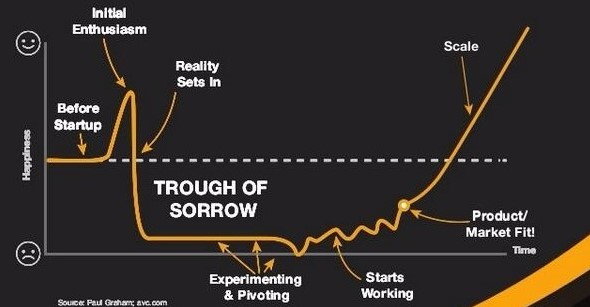
One of my favourite diagrams to describe the start-up journey is the Start-up Curve by Paul Graham.

The Startup Curve graph; by Paul Graham, avc.com

The Startup Curve graph; by Paul Graham, avc.com

The amazing initial enthusiasm that carry away the entrepreneurs, the diving into the trough of sorrow when the start-up is fighting constantly to find its’ way in the market, up to the golden point when the start-up hits the Product-Market-Fit and begins to scale.

But this graph is also misleading, almost a lie, as it’s totally out of scale. The reality is that the first stage, before reality sets in can take from a few days up to few weeks, no more than that. Then the time scale in the trough of sorrow, well… that can take a few years and might feel like an eternity. Like a thirsty and hungry person who is lost in the middle of the desert, without a map or compass, who can only see the horizon in the same shape and distance, every single day — the only powers that give them the strength to continue are faith and determination.

The feeling I had when I invented Whichit a few years ago was spectacular. A period full of energy, enthusiasm, creativity and pure initiative — aiming to change the way marketers interact with their audience. It’s been 4 years since I founded Whichit, relocating from Israel Startup Nation to Great Britain alongside my two Co-Founders, Yarden and Galit. A long and hard journey that taught me one main thing about tech start-ups: It’s not about the idea, but it’s all about the execution of the founding team, over a period of time.

Even today, after few years of running our start-up, with rich experience in the Trough of Sorrow, we are still holding the faith and belief of the idea. We can feel and see it in every aspect of the business — from the support and care from our investors, who joined us on this long journey, our business partners who recognize the unique and innovative value we are bringing to market, the successful commercial activities with our clients who are growing by the week and last but not least, our team: technically “employees”, but practically they are the soul of the start-up and keep on fighting even in the darkest hours; a team you want by your side when you’re building a tech start-up.

Being a Founder-CEO of a hi-tech start-up is a bitch (excuse my French). Long hours, hard work, working under constant uncertainty, great responsibility, constant concerns. As a Founder-CEO you are overloaded at every single moment, dealing with millions of tasks that cross every aspect in the business world no matter what your background is, while you have few resources. Every day is a challenge that becomes a struggle, getting “Nos” on a regular basis and still trying to continue like nothing happened. To be the Founder-CEO of a hi-tech start-up is doing the impossible every single day.

I was fortunate to have two super talented Co-Founders. Yarden, our CTO, covering all technology aspects of the business. From taking the concept and the initial definitions to full production. Even though when we began he didn’t have full knowledge and experience of several technologies and code languages, he was able to learn and perform with almost a vertical learning curve, with extraordinary talent and improvisation to achieve our product goals.

Galit, out Creative Director, is the master talent of the company. Basically, every single pixel in Whichit: it’s her design. From the creative language, the commercial campaigns, marketing and sales materials, website, blog and social channels, up to the full definition of the products, the user experience and interface. Thanks to her talent and creativity, we won the ‘Start-up of the Year’ from Facebook in 2015.

As we already know, talent is very important but not enough. The core team never stops surprising me with their dedication and hard work, sometimes with sacrifices of very late nights, working during weekends and holidays. Constantly communicating around work to execute our plans successfully. Getting into the small details and putting their care and personal touch in every corner of the product, services and piece of work, putting their soul into the tech.

The WBS Of The Founder-CEO

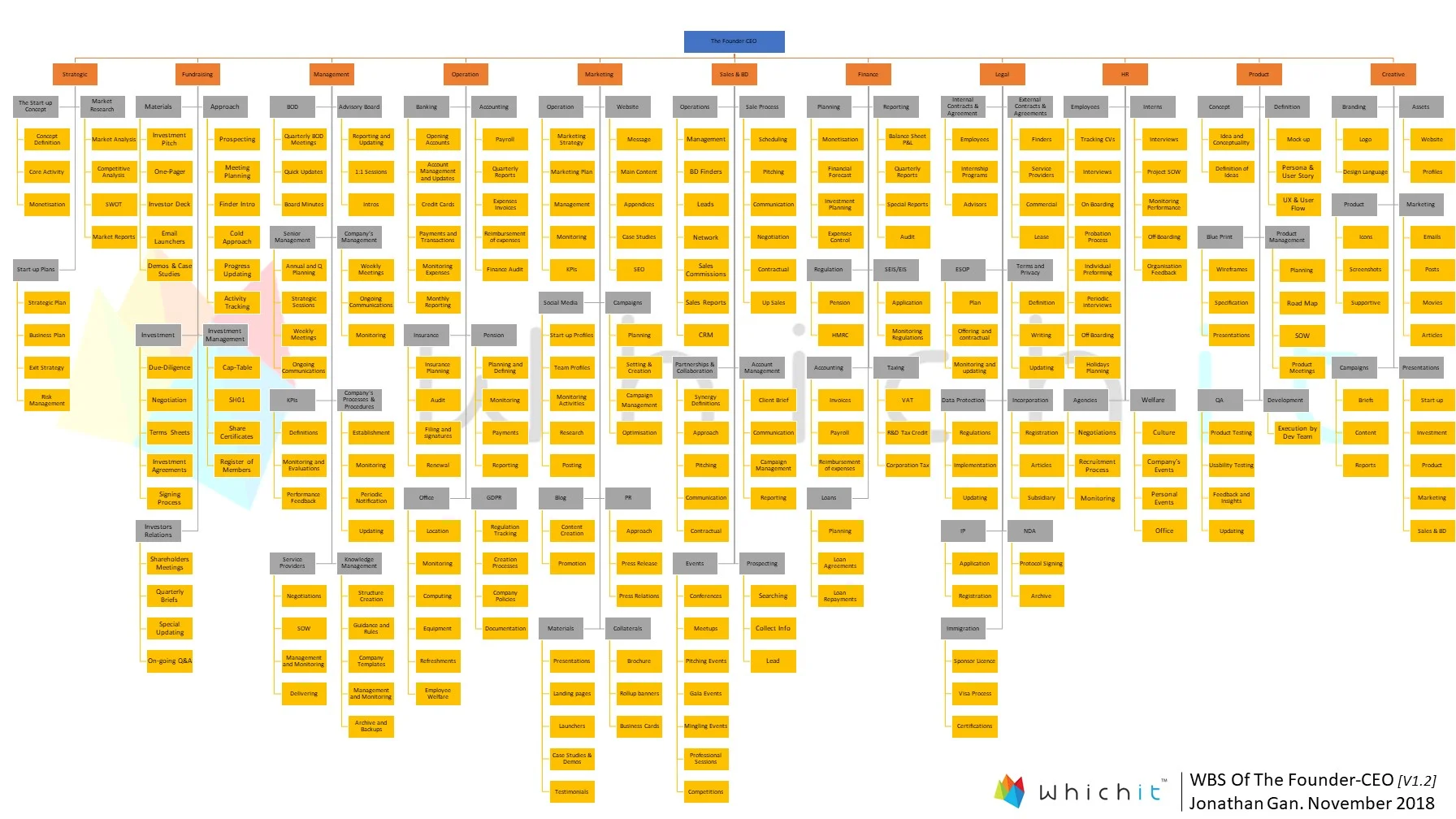
I had the chance to look back, reviewed all the disciplines I was involved with in the past few years of running my tech start-up. The millions of tasks spread across every domain and industry exists in the startup and business worlds. I don’t think there is a better school or degree that can teach you what can be learnt in a single year as a Founder-CEO of a hi-tech start-up.

The WBS Of The Founder-CEO [see full picture]

The WBS Of The Founder-CEO [see full picture]

I created this Founder-CEO WBS (Work Breakdown Structure) diagram, which contains every domain and Scope Of Work (SOW) I personally dealt with, while running my tech start-up, Whichit. There are three levels of involvement I’m defining for each scope of work:

  1. Full — From definition and planning to delivery and full execution of the scope of work.

  2. Partial — Taking active part in the task execution, together with colleagues or a service provider.

  3. Shell — The action(s) taken was one or more of the following, while the actual task was created and delivered by someone else: planning, defining, managing, controlling, reviewing, mentoring, guiding.

As Founder-CEO of a hi-tech start-up, you will find yourself dealing with ALL of these components, while your level of involvement in each of them in the beginning of your start-up will be entirely on you, the more progress you make and the more team members you have, the level of your involvement will decrease, still everything depends on you. You may not have the professionalism, or you may not like a lot of these tasks (who likes to deal with GDPR or creating a company’s manual?!?), but like it or not, the execution of your tech start-up is dependent on each and every one of these small parts.

The T-Model In Professionalism


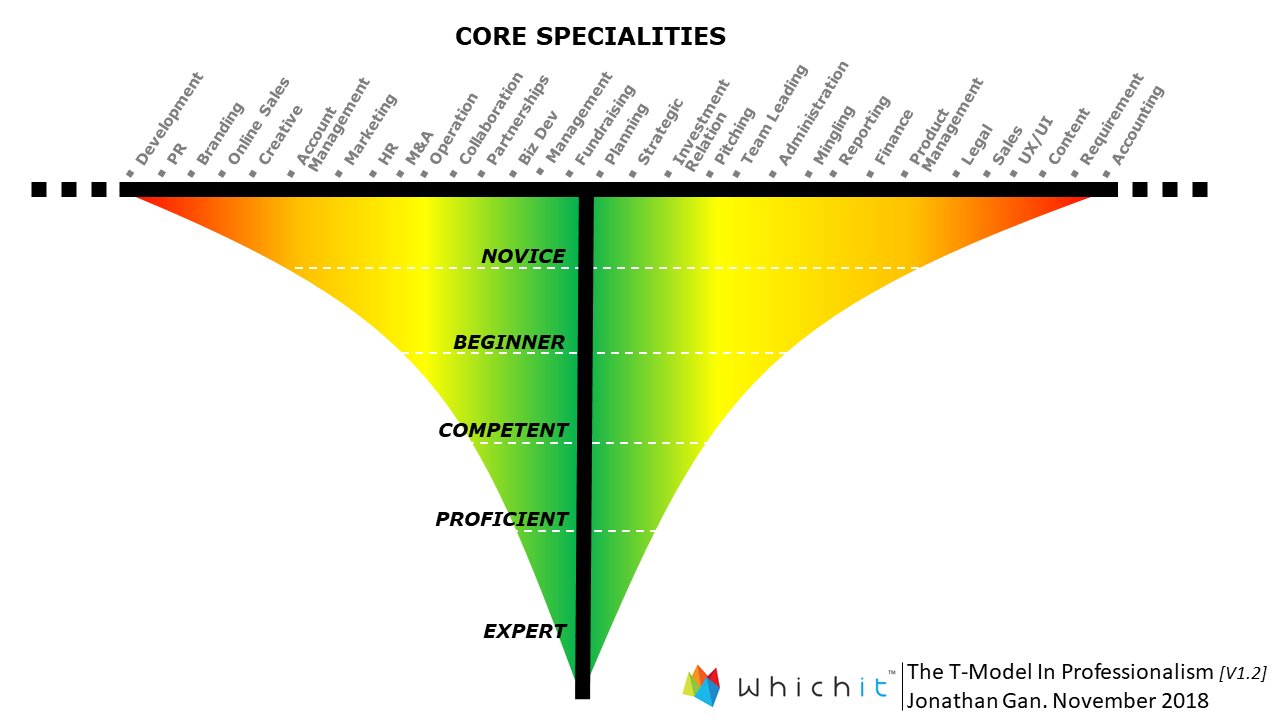
As you can imagine, it’s impossible to be an expert in every single discipline in the industry, nevertheless having the time to deal and manage everything together. The following model I created represents the variety of domains (horizontal) in the tech start-up world and the level of professionalism in each aspect (vertical). While the middle point is YOUR core professional domain, the more you move away from the center, the less professional YOU are in these domains.

The T-Model in professionalism is personal and will be different for each person. The goal of using it is to better understand where your strengths and weaknesses are in terms of knowledge, understanding and professionalism in each aspect of the start-up world. As an output, it will enable you to concentrate on working with your core specialties and expertise, while having others cover the specialties you are weak in.

The T-Model in Professionalism

The T-Model in Professionalism

As I mentioned before, EXECUTION is the key ability in a tech start-up. Not the idea itself, nor the tech, not the market and for sure not how much money the start-up has raised.

In its first years, until it becomes a stable company, a tech start-up IS NOT based on the traditional business models of T&M (Time and Materials) nor Bricks and Mortar, but more as an ongoing project, with a general direction and goal that is represented in a heuristic concept and with low resources to none.

Execution is defined as the ability to carry out a plan, order, or course of action. In simple words for the Founder-CEO of a hi-tech start-up, it is your ability to:

  1. Understand the start-up’s current situation.

  2. Measure your direction and distance to the main goal.

  3. Recognize the gaps and up-coming challenges.

  4. Translate gaps and challenges to tasks and prioritize.

  5. Act.

  6. Repeat. Every single day.


Good luck with doing the impossible possible and may the force be with you.


Jonathan


Whichit is an interactive commercial content platform that enables marketers and advertisers to increase user engagement, open new revenue streams & gain user-related insight. The company has an innovative technology that profiles users based on their preferences and uses machine learning to provide bespoke commercial incentives in real time.

The company is working with top agencies and brands and based in central London.

Breaking News: Whichit has been selected to take part in 365^x Business Accelerator.

Image credits: Sarona Space

Image credits: Sarona Space

Written by: The Whichit Team


We are incredibly proud to announce that Whichit has been selected for the 365^x Business Accelerator, launching in Israel.

The 365x Accelerator is a business enhancer that prepares Software and IoT startup companies for exponential growth. Surrounded by talented executives and entrepreneurs, startups have the possibility to sharpen their business, product and technology, while accessing an international customer and distributors network to affirm solid traction towards scalability.

The selection process was based on three criteria, product, innovation and traction. The chosen startup had to offer a software based or IoT product with disruptive innovation or cutting-edge technology, as well as an initial traction with pilots or customers. We are pleased to say, Whichit matches all of them.

Backed by three global leaders, Microsoft, Prodware Group and Tech Data, the program will take part in the city of Kfar Saba, Israel, for six months. Whichit will be assigned an experienced coach in sales and business development that will help strengthening the company’s strategy and roadmap and structuring the product, technology and organization to work at scale and sustain exponential growth. In addition, this period will have frequent market feedback, global customer reach and tight support to reach actual business agreements with customers and partners. Generate sales, close reseller partnerships and reach the required traction to fit the criteria of “Series A Round” investment.

Since crossing the Product Market Fit threshold at the end of 2017, Whichit has seen an exponential trajectory of growth focusing on the UK and EU markets that has laid foundations for continual growth.  Delivering innovative marketing and advertising solutions to tier-1 brands and advertising agencies, enables them to better engage with their audiences, convert traffic into revenue and gain actionable insights. This program is a great opportunity to extend Whichit commercial operation and company growth.

Together with Whichit’s innovative and proprietary technology, a machine learning profiles users in real time based on their preferences, offering a more personalised approach to marketing and advertising, positioning itself at the forefront of its field and gaining a key business advantage in the market.

In July 2018 the company release a new and improved version of its flagship platform ‘Whichit for Advertisers’, a SaaS platform that caters to the SME and SMB markets. It enables advertisers to seamlessly create interactive commercial content, create and manage commercial campaigns on multiple channels including Google’s Display Network, where Whichit is part of an elite that are 3PAS certified by Google, social networks and programmatically.

In the past few years, Whichit has won several awards. In 2015, the company won The Sirius Programme by the UKTI, Pitch@Palace 4.0 People's Choice Award, and Facebook Startup of the Year EMEA 2015. In 2016, Innovate UK Smart funds TSB Project. The year after, Whichit was included in The Leap 100 2017 List and won two awards by Finances Online, Rising Star and Great User Experience.

The Sciences Behind Whichit

Jonathan-Gan.png

Jonathan Gan
Founder & CEO


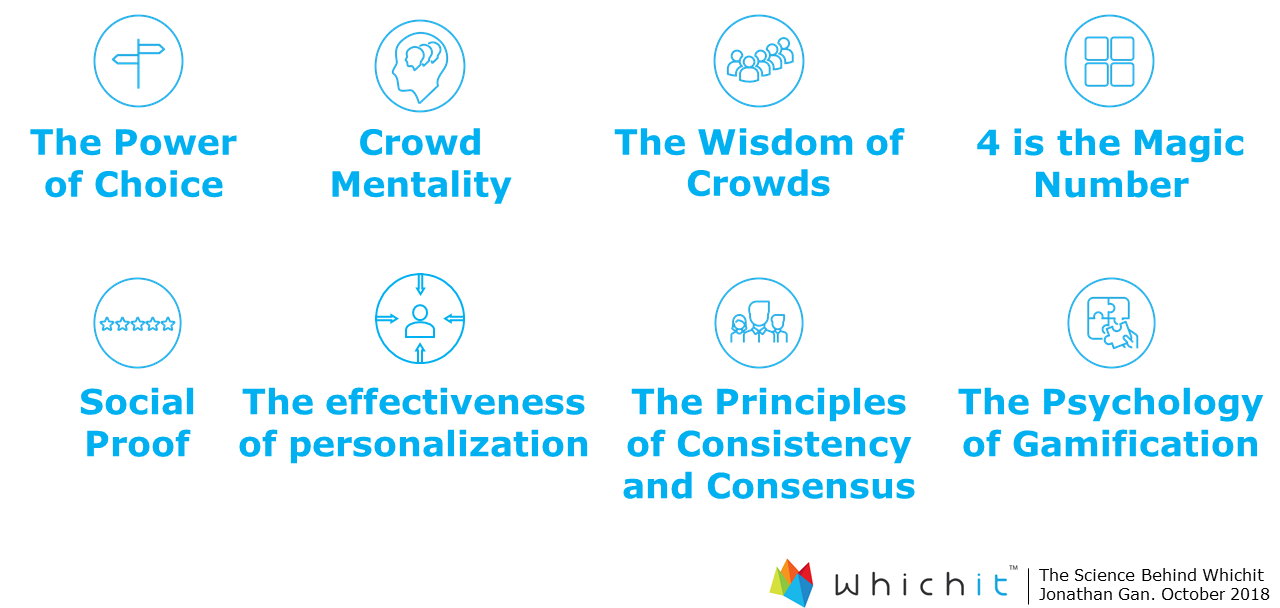
If the Whichit Interactive Commercial Content (ICC) is so effective, it is only due to the fact that the psychology behind it is very powerful. Understanding why the technology that Whichit utilizes has so much potential comes from looking at what happens behind the scenes and the very foundation of the concept. From the first year when we started to define and build the product, and even those days with the next generation of the Whichit for Advertisers, we used those eight science principles as a core guideline in order to achieve a powerful and useful tool for our users’ clients and their customers, while also building the technology around it.

 
One Slide The Science Behind Whichit.png
 

Let us take a look at the aspects that make the Whichit Interactive Commercial Content so powerful, by analysing what is happening in a user’s head when he/she is engaging with this type of content.

1. The Power of Choice

The power pf choice2.png

Learning how to make your own decisions is probably the first responsibility you earn as a child. For instance, you learn to decide what color tee-shirt you prefer, what flavour of ice cream you ask your parents to buy you, or what you want for your birthday.

Choosing is in our mind forever, and our everyday life is comprised of a number of choices that we make with each passing minute. The result is that people love having choices and love making choices. As a marketer, offering choices to a customer helps to transfer the power to the customer, putting his/her personal choice first, thus creating a more democratic relationship.

Let’s take a look at an example: have you ever walked down the street and felt really annoyed by people trying to give you a flyer? This annoys you because the person is trying to impose something on you, that you did not ask for. More specifically, something that you did not choose. Now think about this situation in a different way; what if that person had offered you the choice between two different elements? Fundamentally, it would have been different, right?

Indeed, it has been proven that in a situation relative to choices, humans often turn to take an action and choose one of the options rather than be passive, even if they don’t fully know or understand all of the information related to their potential choices.

In Sheena Lyengar’s speech at TED Global 2010 about the art of choosing, she explains that our choices are often quite similar: The value of choice is created based off of the ability of someone to perceive differences between the options.

This power of choice is the first principle that Whichit applies: instead of imposing one single element to a potential buyer, Whichit is offering multiple choices to customers through polls, surveys, trivia, and other types of interactive content. In this way, the end-user can do what he or she feels is most easy to complete. Users can express their preferences by choosing from default options. In addition, users tend to feel better understood and listened to.

2. Crowd Mentality

Crowd mentality2.png

The crowd mentality (also called the Herd mentality) describes how people can be influenced by their peers to adopt certain behaviors on a largely emotional, rather than rational, basis. When faced with a decision, humans often turn to the people they trust for guidance, resulting in a choice that is likely influenced by their peers or society as a whole. In simple words, the herd mentality describes a behavior in which people act the same way or adopt similar behaviors as the people around them — often ignoring their own feelings throughout the process.

The Whichit Interactive Commercial Content can be described as a psychological funnel delivered as a game. Even though the topic of the content is not necessarily in the user’s core interest, they will be attracted to engage with it in the first place for two key reasons that can be categorized under the crowd mentality:

  • Joining the crowd: “Many people are already engaged, I’d like to try it as well”

  • Comparison: “I want to know how I perform compared to the others.”

 
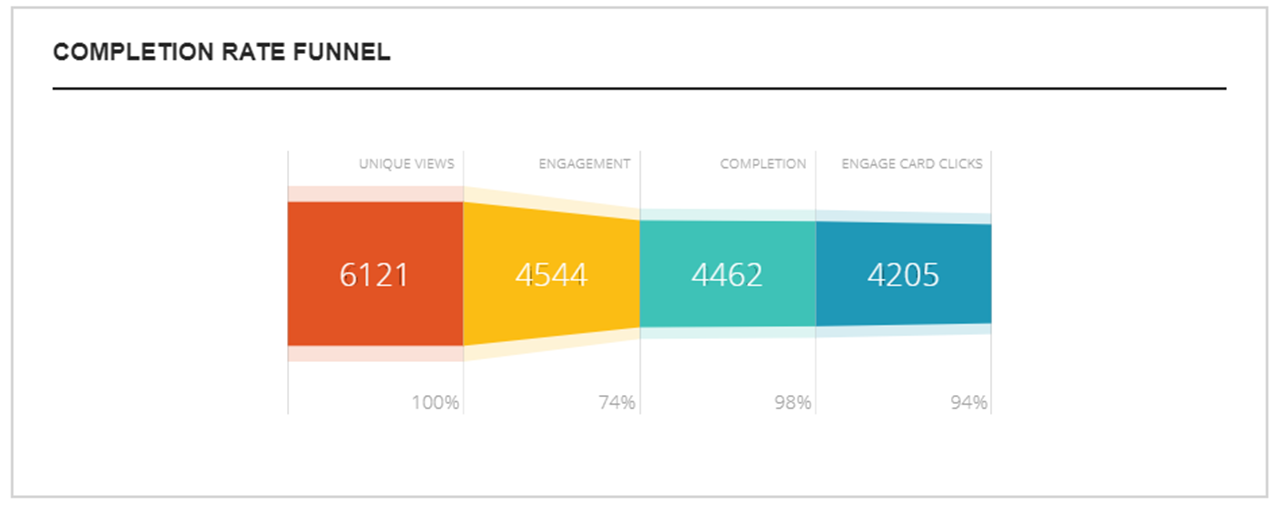
The Whichit Funnel [Whichit for Advertiser Dashboard Screenshot]

The Whichit Funnel [Whichit for Advertiser Dashboard Screenshot]


Based on those principles, Whichit decided to present users with the first message in a clear and appealing manner, and after their first engagement, Whichit would continue with a smooth and clean user-experience and interface to ensure high performance and conversion throughout the series of questions attached to the interactive content. Users will eventually earn the Whichit Commercial Engage Card.

3. The Wisdom of The Crowd

The wisdom of the Crowd2.png

The collective opinion of a group of individuals is more accurate than the opinion of a single expert. This notion was most compellingly justified in James Surowiecki’s book, “The Wisdom of the crowd,” but its origin comes from Francis Galton’s observation in 1907: He observed that the average of answers to a “guess the weight of the ox” contest was extraordinarily accurate, even more accurate than the expert guesses. Lior Zoref repeated this experiment on the TED stage in 2012.

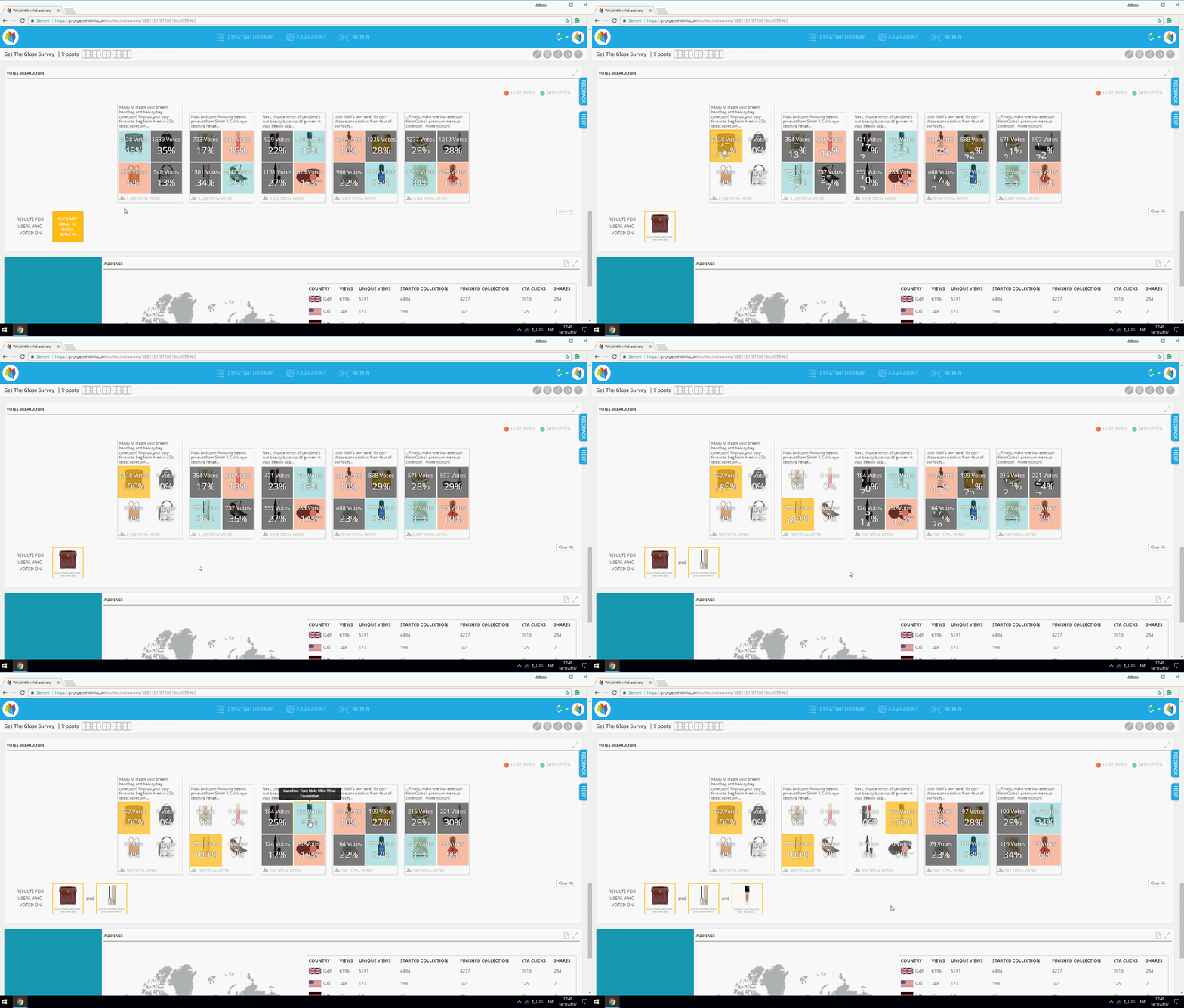
When it comes to Whichit, we gave the marketers direct access to all the answers. The preferences of the audience to the interactive content such as the polls, surveys, or quizzes provide valuable information on the accurate preferences of the users. The Whichit dashboard delivers a lot of information throughout a campaign and the corresponding creative levels, providing actionable insights and mini market research with the tip of a finger. Through this analytics, the marketers in the agencies, and the brands themselves can synthesize micro-audiences in seconds and discover their preferences. Learning, for example, that 40% of people that like the black boots also love the yellow backpack, and 78% of them are going on Ski holidays at least once a year. By analysis, there is no better way to determine the various profiles of potential customers within the audience.

 
Votes Breakdown and statistic Correlation [Whichit for Advertiser Dashboard]

Votes Breakdown and statistic Correlation [Whichit for Advertiser Dashboard]


4. Four is the Magic Number

Choosing is a basic instinct, inherent in our homo-sapiens brain. It is magical to see the reflex of the Human brain when asked a “Which” question rather than an “open” question. The differences are shocking every single time.

By its definition, choosing is picking the best or most appropriate of two or more alternatives. So, at the minimum, there must be 2 options. While the maximum number of options could be as much as we want, even dozens or millions, according to Sheena Liyengar’s talk, when you give people 10 or more options, they make poorer decisions.

So, what will be the optimal number for multiple-choice items?

Three options are optimal for multiple-choice items. Michael C. Rodriquez, University of Minnesota, carried out a meta-analysis of 80 years of research to synthesize these results to estimate the effect that the number of options in multiple-choice items has on test score reliability and validity.

In addition, the human brain can most effectively process up to four things at a time: When more than 4 options are given, the ability to focus is diminished. This can be explained by the “Working Memory.” Working memory relates to the information we can pay attention to and manipulate, or in other words, the temporary storage of information.


A Whichit Post contains a textual question, along with 2, 3, or 4 visual options in the form of multiple-choice questions. The images are with or without overlay text. The structure of the Whichit Post is rectangular and symmetrical, with subtle design lines. We limit the options to 4 and the images are squared.

Those design guidelines and restrictions achieved higher engagement from users in answering a Whichit Post with multiple questions consisting of polls, trivia, or quizzes. In addition, the guidelines provide a smooth user experience and interface, with added fun for the experience of the user.

5. Social Proof

Social proof is the idea that consumers will adapt their behaviour according to what other people are doing. There are 5 main types of social proof:

  1. Expert

  2. Celebrity

  3. User

  4. “Wisdom of the Crowds”

  5. “Wisdom of your Friends”

Different types of social proof lead to different influences and needs to be used wisely according to the specific situation and the user’s experience.

 
4 star.jpg
 

In Whichit, we are using several types of social proof simultaneously:

  • The Wisdom of The Crowds Social Proof — As an integral part of the Whichit questionnaire; includes showing the results as feedback on the user’s preferences for each post and in the end of the Whichit questionnaire as a summary of all feedback.

  • The Expert / Celebrity / Wisdom of Your Friends Social Proofs — As the distribution channels; includes validation of the content when sharing and distributing the Whichit content, in addition to supporting the viral wave and the organic reach.

Example: Birchbox quiz

Example: Birchbox quiz

The Whichit content is defined as interactive from its nature and people want to engage with and inquire about their results — “How do I compare to the others?” Their instinct to tap into their digital ego by understanding the social proof is natural, and it leads to the following Whichit USPs:

  • High engagement

  • High completion

  • Sharing the content

  • High conversion on the Whichit commercial Engage Card

6. The Effectiveness of Personalization

Personalization is key for driving high performance and conversion. The more tailored the content and experience become to the individual and his/her personal preferences, the more likely they will continue to engage with the content and ultimately convert.

The Effectiveness of Personalization3.png

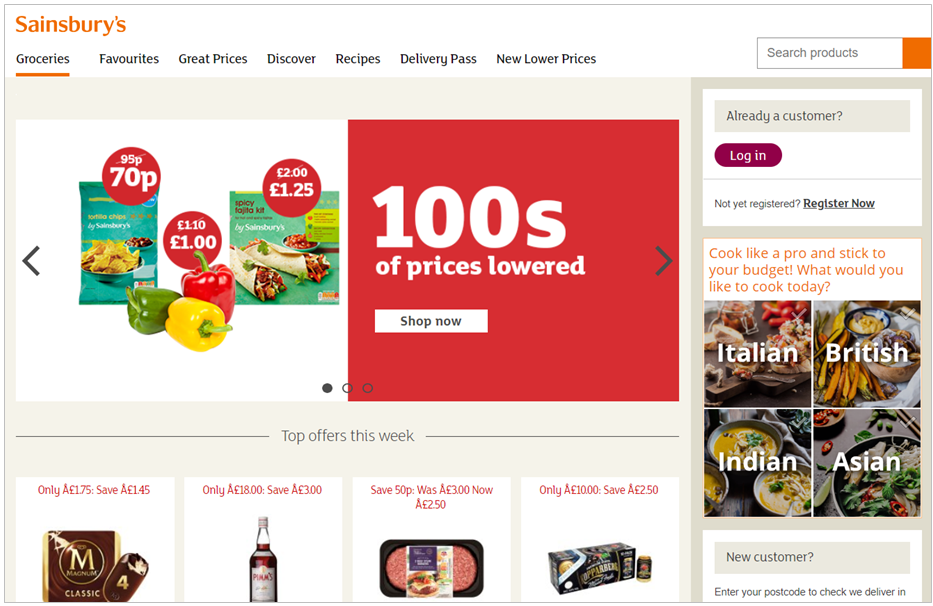
In Whichit, we took personalization to the next level! We appeal to the audience with attractive and interactive content, reaching to the “rainbow of people,” and leading them via a personal path. We are getting to users in the decision-making point with a bespoke commercial offer that they will likely engage with. Everyone likes to feel that they receive special treatment tailored to their needs, even when it comes to content consumption. But, by delivering personalized interactive content to our customers, Whichit makes them feel like the brand understands their unique needs and their interests.

Sainsburys.png

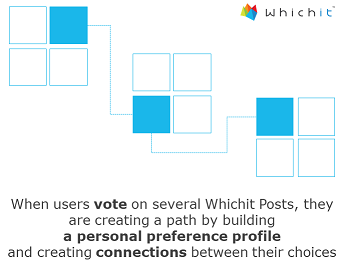
Moreover, through the Whichit Interactive Commercial Content, while users engaging with the content, they are creating personal paths with each stage. The number of possible paths for each Whichit Post is exponential and being raised by the fourth power (n4, n=number of Whichit Posts). Those paths are translated into micro-segments, effectively colouring micro-audiences from the same traffic flow in just a few steps.

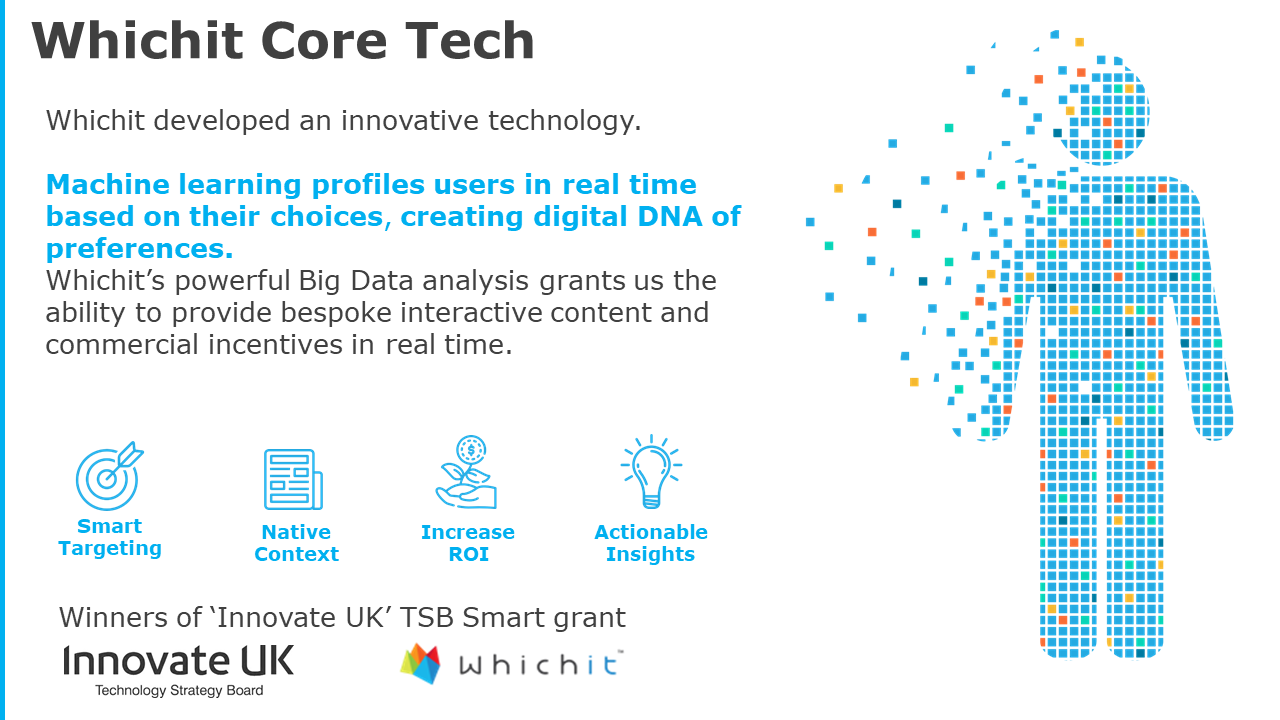
There is an even deeper level reached within Whichit — we invented an algorithm, a machine learning algorithm that profiles users in real time based on their preferences. By using the Whichit Posts as sensors to recognize user’s preferences, we changed the way marketers engage with their audience.

 
Whichit Core Tech.png
 

By recognizing and analysing user’s preferences, the Whichit Machine Learning algorithm, winner of the Innovate UK Smart TSB, allows marketers to:

  • Categorise users into preference groups

  • Segment users based on demographics

  • Identify future trends

  • Identify anomalies in trends

  • Getting to users in the decision-making point

  • Tailor content and commercial offers to users in real time

  • Position options based on the wisdom of the crowd

7. The Principles of Consistency and Consensus

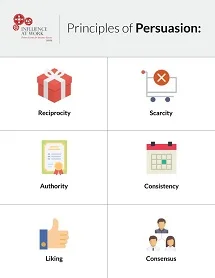
In his book “Influence”, Dr. Robert Cialdini exposed 6 famous principles of persuasion: Reciprocity, Scarcity, Authority, Consistency, Liking, and Consensus (Social Proof). In the case of Whichit, two principles are playing an important role:

  • The principle of consistency

  • The principle of consensus

The Principles of Persuasion; “Influence”, Dr.Robert Cialdini

The Principles of Persuasion; “Influence”, Dr.Robert Cialdini

The principle of consistency refers to the fact that people like to be consistent with the things they have previously experienced or expressed. That consistency can be activated by encouraging people to engage in small initial commitments, such as answering a survey. A study in a health centre showed that if people were asked to write the hour of their appointment down themselves, missed appointments would be reduced by 18%.

Engaging with Whichit Interactive Content requires a very small commitment by users. In addition, the interval of the engagement is quick and instant, which drives consistency within the user’s responses on their preferences. This is one of the fundamental principles that the Whichit Machine Learning algorithm is based on, in order to profile the users based on their preferences, rather than through traditional marketing methods.

The principle of consensus, similar to the “Crowd Mentality” and “Social Proof” (see previous chapters), means that people will look to the actions and behaviours of others to determine their own, especially when they are uncertain. Most likely, you have noticed the small notice in your hotel bathroom encouraging you to reuse your towel to save water. It is said that about 75% of people who check into a hotel for four nights or longer will reuse their towels at some point during their stay. A study on the principle of consensus looked at what would happen if it was included on the cards that 75% of guests reuse their towels at some time during their stay. It turns out that towel reuse rises by 26%, which had confirmed the principle of consensus.

8. The Psychology of Gamification

“People can be made to be more intrinsically motivated simply by presenting an activity as a game,” Andreas Lieberoth explains.

The Whichit Interactive Content can be compared to a game: it enables users to transform a traditionally one-sided, non-engaging experience into an exciting, personalized, and enjoyable experience. Interactive content will always seem more appealing to the brain as opposed to standard text.

Since 2011, gamification becomes a trend, and these days it’s almost a basic function in user-experience and interface development. Gamification is the process of using game-like elements when designing business and marketing strategies. The reason for this being that gamification works. It triggers real powerful human emotions such as happiness, intrigue, and excitement; these are positive user-experiences, and positive a user-experience leads to better engagement, loyalty, and higher sales.

We are using the Whichit Interactive Commercial Content to deliver information and to interact with the audience in a playful manner. This approach delivers higher results on nearly every level: engagement, completion of polls and surveys, commercial conversion, and data collection.


Whichit is an interactive commercial content platform that enables marketers and advertisers to increase user engagement, open new revenue streams, and gain user-related insight. The company utilizes innovative technology that profiles users based on their preferences and uses machine learning to provide bespoke commercial incentives in real time.

The company is working with top agencies and brands and is based in central London.

Our Story; From Startup Nation to Great Britain

Jonathan-Gan.png

Jonathan Gan
Founder & CEO


It’s been four years since we landed in London. Three young professional Israeli entrepreneurs, with a big idea and nothing else. Four years we worked every day, fighting to survive in the startup juggle, searching in the dark to find the golden cup in the local market. Sometimes we see it, even holding it for a while, enjoying those small victories in the endless and cruel start-up journey, and then going back to work, putting our full energy in our venture, with the belief that one day we’ll enjoy the fruits of our labour. In a nutshell, this is our story.

Don’t Worry, Everything Will Be Fine


As an Israeli I can say that this is one of the most used slogans. It would be an understatement to say that it is not one of the smartest. You’ll quickly find yourself in a situation in a wise man would never dare enter. But on the other hand, from my point of view, it is one of the chromosomes that an entrepreneur must have — to dare.

At Tel-Aviv airport with just a trolley, waiting for the flight to London, April 2014

At Tel-Aviv airport with just a trolley, waiting for the flight to London, April 2014

We started with a bunch of guys, a lot of help and support from friends, working to develop a crazy idea I had. With a basic version that looks like… well… basic and just few months into the project we won the Sirius Programme of the UKTI. A UK government program that choose around 60 startups worldwide, offering them to relocate to the UK and develop their startup in the local market, with a small grant, a 3 months accelerator program and an office for a year. You, just need to leave your home, your family, your friends, your network and build your start-up in a new market. The rest is up to you.

Five minutes, that was the time it took to make the decision. We are moving! In just a couple of months we sold the car, the motorcycle, ended our apartment leases. We packed the whole house into boxes and stored it all in a long-term warehouse. Bought tickets on a low-cost flight and went to the airport with just a trolley and five boxes to be sent in a week’s time. Don’t Worry, everything will be fine.

The British Paradox


A business card. The basic information that represents you and your business. A small piece of paper that every business person has. It took four and a half months to get one in the UK.

In order to have a business card, you need to have a normal local phone number so people can contact you. In order to have a normal UK phone number you need to have a contract with one of the telecom suppliers. In order to have a contract with one of them, you need to have a local UK bank account. In order to have a UK bank account you MUST HAVE a local home address, with the original council tax set to your name. But in order to rent a flat in the UK you MUST HAVE a bank account. But in order to have a bank account, you must have an address… I call it the “British Paradox”.

That was one simple example, out of many, that represents the basic most simple and obvious things in life for a local resident, are a struggle for the foreign person, like us. Add that to the life of the entrepreneur and you just start to imagine the number of hurdles we needed, and sometimes still need, to overcome on a regular basis. Sometimes people, mainly in potential investor meetings, asking me why it took us a few years to get to where we are, like building a start-up and in a foreign country should be in the blink of an eye … I always hold myself from explaining all the reasons, because if you never ran a marathon with no end point in the middle of the desert and with no water, you’ll never understand the feeling of an entrepreneur.

The Team is Everything


That’s what every investor will tell you, that’s what every entrepreneur will testify. And I can say the same. Most of the start-ups that failed, the core team was the main reason. Whether it was an internal dispute, the team wasn’t strong enough or not fit to the role. The core team is the heart of the start-up’s success.

Galit (Creative Director); Yarden (CTO); Jonathan (CEO)

Galit (Creative Director); Yarden (CTO); Jonathan (CEO)

Throughout the years, many employees passed through our company. We always kept our team small, professional and highly motivated, in order to keep the company, lean, effective and efficient. But the core team was always there. Each of us have our own specialty, and our own individual personality. Together, we complemented each other and bolstered our strength.

Along the way, I noticed that we literally taught ourselves almost everything we know today in the start-up world and in our industry. Yes, each of us have rich experience and knowledge in our domains from past roles, and all of us are holding advanced degrees from top universities. Yet, just with a crazy idea on a power-point, we found ourselves dealing with new technologies, new markets, new materials, new tools, a new country, a new network, new everything. We challenge ourselves to learn on the go; planning, building, trying, testing, failing and then again… and again… and again…

A start-up is not about the idea, its all about the execution and execution is made by the team.

Small Victories Its All You Need


Building a B2B technology start-up from scratch it’s like the David and Goliath story, but this time there are a lot of them and you’re more like a baby-David. Trying to go through the massive corporate doors, proving your product in a competitive market where big tech companies dominate the market and thousands more are jumping from all over, trying to bite the cake, and then the long and clumsy sales cycle. While all this time you’re looking to survive your basic existence with investment and trying to manage hundreds of administration and operational tasks to keep the machine going on. You and just a several team members.

But it doesn’t mean you can’t enjoy the small victories along the way. Those are actually the most important, as they are the light-bits for the entrepreneur. The orange peel trail in a long and bumpy road. Those small victories reflect that you’re on the right path. Indicate that you’re still alive.


Whichit. Startup Introduction 2017


A year after we landed in London, we won the ‘Start-up of the Year EMEA’ by Facebook, later on the year we won the People’s Choice Award at Pitch@Palace by the Duke of York and we won the Innovate UK R&D Funding Award with a £250k grand to develop one of our algorithms.

As we were determined and consistent with the concept of the idea, playing with the product definition, testing different angles and messages to the target market, we have been able to hit the golden point of the start-up — the Product-Market-Fit. From that point the target market started to convert and became clients, the conversations became deals and revenue and the search mode turned to growth.

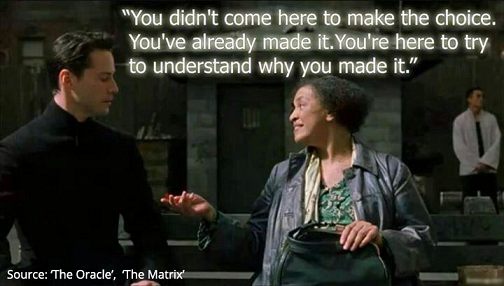
It was like in the Matrix movie, when Neo saw the Matrix. We then knew and saw the perfect formula. What we need to do, how and where. It’s not the end goal and no champagne will be open just yet. We still have a long ride in front of us and the odds are still against us, like any other tech start-up. But we have been able to overcome another step on the way to the cockpit, enjoying the small victories along the way.

To be continued…


Whichit is an interactive commercial content platform that enables marketers and advertisers to increase user engagement, open new revenue streams & gain user-related insight. The company has an innovative technology that profiles users based on their preferences and uses machine learning to provide bespoke commercial incentives in real time.

The company is working with top agencies and brands and based in central London.

Case Study: How Letts Revision drove new customer acquisition and brand awareness

Written by: Chloe Rowan


Harper Collins Publishers is the second largest consumer book publisher in the world. In March 2018, they started a 15-day Whichit campaign to increase brand awareness and drive sales for their Letts Revision range, targeting GCSE and A Level students and their parents.

Whichit creates interactive and engaging adverts, mostly in the form of quizzes, trivia, surveys and polls. They designed two single posts to appear on Facebook, and a humorous video ad for Snapchat. All adverts ended with a Call-to-Action, and one Facebook post was aimed at single mothers aged 35-55 with 15-18 year old children, while the other two ads were aimed at 15-18 year old children.
Click below to see the video>>


The Snapchat ad saw over 1 million impressions, 42,000 swipe ups, and 30,438 unique views to the Whichit quiz which was linked in the Call-to-Action at the end of the video. The Facebook ads delivered 195,000 impressions, and the cost per engagement was 50% lower than the education industry benchmark.

The campaign increased reach and awareness amongst secondary school students and their parents, and gained insightful data about their audience’s behaviour.

Do you want similar results?

Launch your Whichit campaign on Snapchat! Captivate your audience with 5X click-through-rate.

Read more on Whichit’s case studies here: whichit.co/case-study

Whichit: Not Just an Enabler Brand

Written by: Chloe Rowan

Disruptor brands are the ones getting all of the attention. They make big noise and take down the competition as they sky-rocket to popularity. But it’s actually good to have options. Having competition means brands need to compete to win over their audience, their audience is not just taken for granted. This keeps prices competitive, ensures high customer service standards, and gives the public freedom of choice.

Having freedom of choice doesn’t always result in people choosing one thing OR the other. Often, people like to use several services or products to satisfy all of their needs. For example, somebody might have Sky, Netflix and Amazon Prime subscriptions as they all have different popular shows and films to offer.

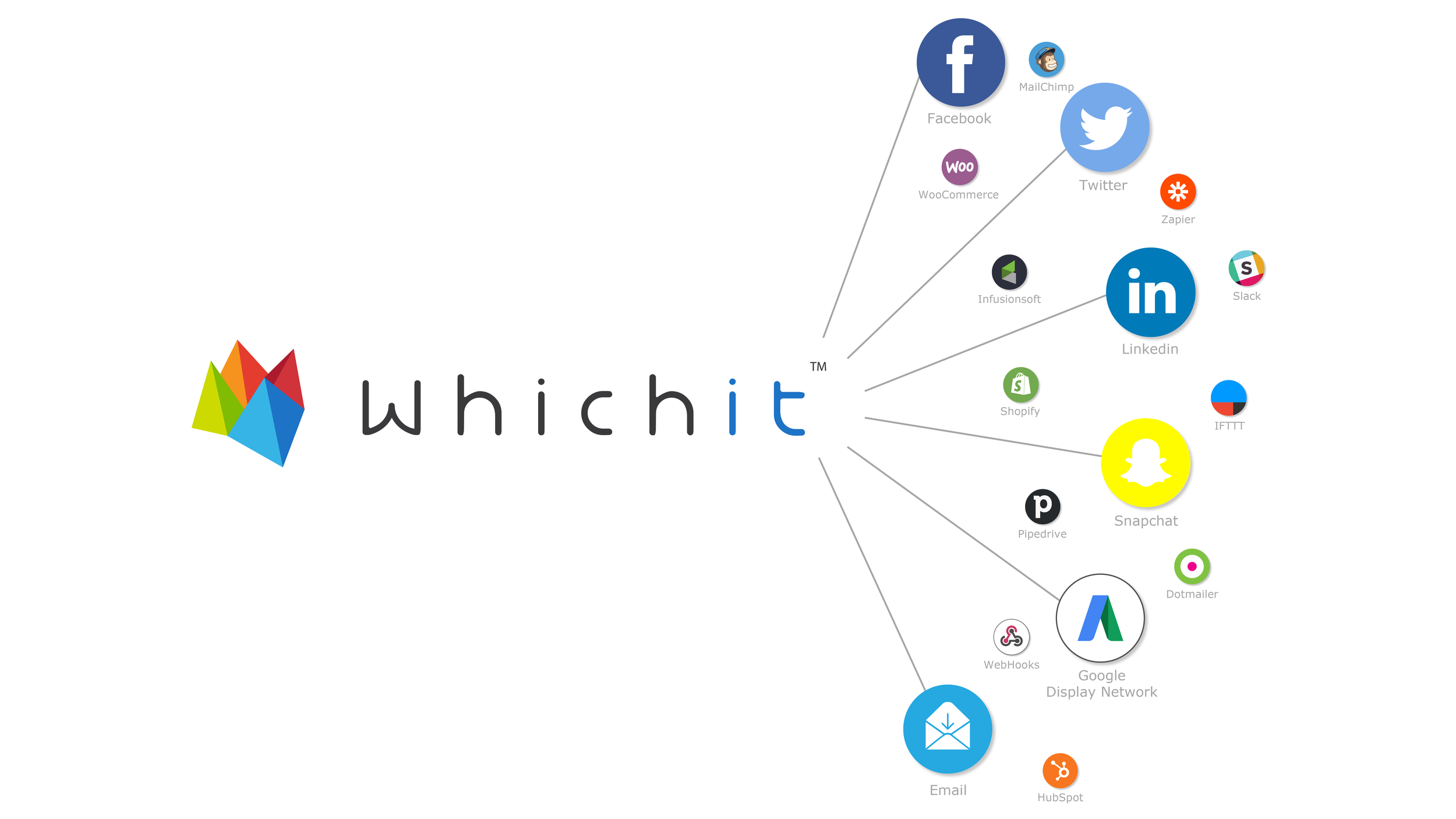
Whichit is an enabler brand. Our interactive ad units are compatible with, well, pretty much every online network! You can share your Whichits to your website or blog, and your social media platforms.

Blast your interactive campaign across multiple channels with Whichit.

Blast your interactive campaign across multiple channels with Whichit.

Whichit can be used as the sole, all-in-one solution for your digital marketing needs. Or, it can be used alongside other advertising solutions. Advertisers can share the Whichit units to just their website landing pages, or they can share them across several different platforms.

Whichits are even compatible with Shopify, and premium blog site, Medium

Whichits are even compatible with Shopify, and premium blog site, Medium

Our users have the power of choice. Whichit is not just an enabler brand, we are whatever you need us to be.


Find out more about Whichit for Advertisers:

https://whichit.co/whichit-for-advertisers/